Assignar and WBSync both serve self-perform contractors — the asphalt, concrete, drilling, piling, earthworks and rail trades that put big crews on plant-heavy sites — but they sit on opposite sides of the working day.
Assignar's day starts before the shift. Its scheduler allocates individual workers, whole crews or assets to tasks in a timeline view, matching allocations to worker availability and qualifications, with drag-and-drop, bulk allocation and automated notifications to the field. Its compliance hub centralises competencies, tickets and licences and fires alerts when documents are due to expire — a genuinely hard problem for civil contractors that Assignar treats as a first-class feature. Around that sit timesheets with geo-location and timestamp verification and one-click export to payroll and accounting (Xero, MYOB and others), customisable digital forms for pre-checks and incident reports, a site diary with cost codes per activity, progress tracking that turns bid items into trackable units of work, and Assignar Pay, its job-costing product with live budget-versus-actuals.
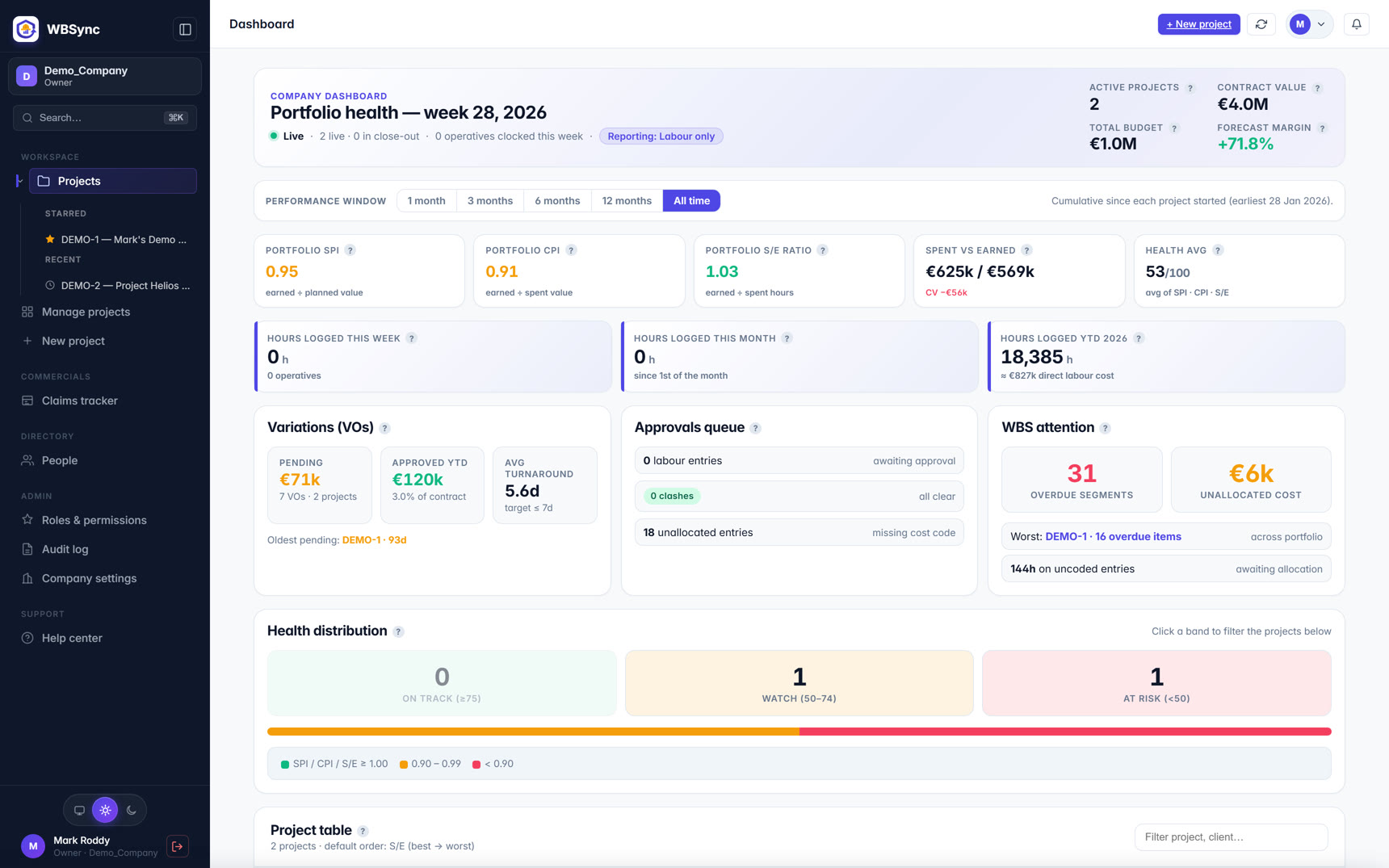
WBSync's day starts after the hours land. You import a four-level work-breakdown structure and BOQ from your existing spreadsheets; hours arrive from a foreman's offline-capable crew-log PWA or automatically from your existing clock-in system through an open inbound API with prebuilt vendor adapters; clash detection and a foreman/PM approval gate stand between every punch and the KPIs; and the dashboards report spent-vs-earned, SPI, CPI, EAC and TCPI live, with S-curves at every WBS level, feeding progress reports and claim packs from the same numbers.
Commercially the models differ in two ways worth noting. Assignar prices by custom quote ("tailored based on your team's specific needs" — book a demo for a number) and lists access to its public API as a paid add-on. WBSync publishes five flat tiers (€249 to €4,999+ per month) by active operatives, with unlimited PM, foreman and QS seats, the inbound clock API included on every tier, and a self-service 30-day trial. On onboarding, Assignar's global head of customer success has said some customers move through onboarding in 14 days but the majority take around 90 days across its five-phase process; WBSync's setup is a spreadsheet import measured in days.
None of that makes one product better — it makes them different shapes. If your bottleneck is dispatch, qualifications and compliance, Assignar was built for exactly that. If your bottleneck is knowing whether the crews you dispatched are beating the tender hours, that is WBSync's home ground. The sections below draw the line precisely, with a public source on every factual claim about Assignar and a combined column for teams considering both.
Reviews at a glance
| Product | Public rating | In one line |
|---|---|---|
| Assignar | 4.6 / 5 on Capterra (72 reviews) [source] | Customer service 4.7, ease of use 4.4; Capterra, GetApp and Software Advice share one Gartner review pool. |
| Assignar | 4.6 / 5 on Software Advice (same 72-review pool) [source] | Minority critical themes: sales-to-delivery expectations, accounting-integration outcomes, mobile usability. |
| WBSync | No review-site listings yet | Launched 2026 — judge it on the 30-day free trial rather than star counts. |
Ratings are third-party review-site averages captured on 7 Jul 2026; they move as new reviews land. Always check the linked source for the current figure.
Where the typical setup breaks
Scheduling tools optimise the plan; they don't measure the outcome. A crew can be perfectly allocated — right tickets, right site, right start time — and still burn 30% more hours than the tender allowed, and a scheduling view will never show it. The measurement usually falls back to a spreadsheet: timesheet exports reconciled against cost codes at month-end, by which time SPI and CPI describe a month you can no longer influence.
Assignar narrows this with its site diary (cost codes per activity, daily budget tracking) and Assignar Pay's budget-versus-actuals. WBSync attacks it head-on: budgeted hours and value ride in with the WBS import, every hour passes clash checks and an approval gate, and the earned-value indices recompute the moment an hour is approved — so the Monday scheduling decision can react to what Friday's crews actually earned.
Feature comparison
| Feature | WBSync | Assignar | WBSync + Assignar together |
|---|---|---|---|
| Product scope | Labour tracking + earned-value management on a 4-level WBS | Operations platform: crew/equipment scheduling, compliance, timesheets, forms, progress tracking [source] | Assignar plans the shift; WBSync measures what it earned |
| Earned-value metrics (SPI / CPI / EAC / TCPI) | Native, to PMI / ISO 21508 conventions, live on every dashboard | Not advertised; progress tracking covers units of work against bids, Assignar Pay covers budget-vs-actuals [source] | WBSync supplies the EVM indices on top of Assignar's field data |
| Crew & equipment scheduling | Daily plans and crew allocation per project; no dispatch board or asset scheduling | Timeline allocation of workers, crews and assets matched to availability and qualifications; drag-and-drop, bulk allocation, automated notifications [source] | Assignar leads this row |
| Compliance / tickets / licences | Not included | Central hub for competencies, tickets and licences with automatic expiry alerts; skills matched to tasks; digital audit trail of safety forms [source] | Assignar keeps this entirely |
| Field time capture | Foreman crew-log PWA (offline-first); operatives need no logins; or hours ingest from your existing clock | Fieldworker app timesheets with geo-location and timestamp verification [source] | Either capture works — one set of cost-coded hours |
| Cost codes & site records | Every approved hour lands on a WBS cost code; clash checks + approval gate first | Site diary processes cost codes per activity, extracts data for progress claims, tracks daily against budget [source] | Shared cost-code discipline makes the pairing work |
| Payroll / accounting integrations | XLSX/PDF export of everything; payroll stays where it is | One-click timesheet export to Xero, MYOB and others; connected integrations incl. Acumatica, Sage, Foundation, QuickBooks Online [source] | Assignar feeds payroll; WBSync feeds project controls |
| API access | Open inbound clock API included on every tier; six prebuilt vendor adapters + generic webhook | Public API offered as a paid add-on [source] | Budget the add-on if you want Assignar data flowing outward |
| Pricing model | Published flat tiers €249–€4,999+/mo by active operatives; unlimited PM/foreman/QS seats | Custom quote — "tailored based on your team's specific needs"; book a demo for a number [source] | One public price, one quote |
| Typical onboarding | Days — xlsx import, invite foremen, connect the clock feed; self-service | Five-phase onboarding; "some customers... in 14 days, but the majority... take 90 days" (Assignar's Global Head of Customer Success) [source] | Run WBSync's trial while Assignar onboarding proceeds |
Each Assignar claim above links to a public source on their website. Spot a stale claim? Email hello@wb-sync.com and we'll correct it within 5 business days.
Before the shift versus after the hours
The cleanest way to see these two products is as bookends of the same working day.
Assignar owns the front end: allocation of workers and assets to tasks in a timeline view, matched to availability and qualifications, pushed to crews' phones with automated notifications. Its compliance hub is the feature civil contractors cite — competencies, tickets and licences in one place, with automatic alerts before anything expires and a digital audit trail of safety forms. Timesheets capture crew time with geo-location and timestamp verification and export to payroll in one click. Forms digitise pre-checks and incident reports. This is operations software in the literal sense: it exists so the right, qualified people and machines arrive at the right chainage tomorrow morning.
WBSync owns the back end of the day. Hours — from its own foreman crew-log PWA or from whatever clock system your crews already use, via the open inbound API — land on an imported four-level WBS carrying budgeted hours and value. Nothing reaches a KPI until it passes duplicate and over-cap clash checks and a foreman/PM approval, and every state change is audit-logged. Then the earned-value layer does its work: spent-vs-earned, SPI, CPI, EAC and TCPI, live, to PMI / ISO 21508 conventions, with S-curves per node, per project and across the portfolio.
Progress tracking versus earned value
Assignar's progress tracking turns bid items into trackable units of work — fieldworkers log hours, equipment and completed units, and you track progress against your bids. Assignar Pay adds job costing with live budget-versus-actuals and AI-assisted invoice workflows. That is real cost visibility, and for many operations teams it is enough.
What Assignar's public site does not advertise is earned-value management — no SPI, no CPI, no earned-schedule indices on its progress-tracking, job-costing or site-diary pages as of the verification date. The distinction matters to a QS or project-controls lead: budget-versus-actual tells you what you spent; earned value tells you what the spend was worth against the plan, and whether the trend rescues or sinks the forecast. WBSync computes the full index set natively because that is the product's reason to exist.
Timesheets, clocks, and who owns capture
Assignar captures time through its own fieldworker app, with geo-location verification, and exports to payroll and accounting systems including Xero and MYOB. Its integrations page lists accounting connections (Acumatica, Sage, Foundation, QuickBooks, Workbench, Simpro, Employment Hero) and offers access to its public API as a paid add-on.
WBSync assumes you may already have a clock. The inbound clock API is included on every tier, with prebuilt adapters for Deputy, ClockShark, QBTime, Connecteam, Hubstaff and Workflow Infinity plus a generic webhook — so crews keep clocking exactly as they do today and the earned-value layer fills in behind them. The honest flip side: WBSync's accounting integration list is shorter — XLSX and PDF exports are the bridge, and payroll stays wherever it lives now.
Implementation: 90 days versus days
Assignar runs a structured five-phase onboarding — kickoff, technical implementation, four to five training sessions, a pilot, then company-wide launch. Its global head of customer success has put numbers on it publicly: some customers complete onboarding in 14 days, but the majority take about 90 days. For a scheduling-and-compliance platform woven into payroll, that investment is understandable — there is organisational change in it.
WBSync's setup deliberately isn't a project: import the WBS and BOQ from xlsx, invite foremen, connect the clock feed, and the first S-curve renders as soon as approved hours exist. Days, self-service, no implementation contract — because the product touches fewer of your processes.
What reviewers say
Assignar rates 4.6/5 across 72 reviews on Capterra, GetApp and Software Advice — one shared Gartner review pool, not three independent datasets — with customer support scoring 4.7. Critical themes in the minority reviews centre on sales-to-delivery expectations, accounting-integration outcomes, and mobile usability; read them in the source and weigh them against your own workflow. WBSync, launched 2026, has no review-site listings yet — the 30-day trial is the honest way to judge it.
The honest case against WBSync
If your operational pain is dispatch, qualifications and compliance, WBSync does not do any of that — no scheduler, no ticket/licence management, no equipment allocation, no payroll export. Assignar was built by contractors for precisely those problems and has 800+ contractors using it. WBSync earns its place only when the missing piece is measurement: live, PMI-grade earned value on the hours your operation already generates. Buy for the bottleneck you actually have.
Implementation timeline
| System | Typical setup | What's involved |
|---|---|---|
| WBSync | Days | Import WBS + BOQ from xlsx, invite foremen, point your clock system at the inbound API. Self-service; no implementation contract. |
| Assignar | 14–90 days (vendor CS statement) [source] | Five-phase onboarding: kickoff, technical implementation, 4–5 training sessions, pilot, company-wide launch. Assignar's Global Head of Customer Success: some customers finish in 14 days; the majority take about 90. |
| WBSync alongside Assignar | Days | Keep Assignar for scheduling and compliance; feed the same cost-coded hours to WBSync via your clock vendor or an export. Nothing is ripped out. |
Who should choose what
| Choose | When |
|---|---|
| Assignar | Dispatch, qualifications and compliance are the bottleneck: crews and assets scheduled against tickets and licences, timesheets wired to payroll, field forms replacing paper. |
| WBSync | Measurement is the bottleneck: live SPI/CPI on real cost codes, an approval gate before hours hit KPIs, your existing clock kept, and pricing you can read today. |
| Both together | Assignar decides who goes where tomorrow; WBSync reports what today's hours earned against the tender — a natural split for self-perform civil contractors. |
| Neither (yet) | You run fewer than ~10 operatives and a disciplined spreadsheet still works. Revisit when re-keying hours starts costing more than software would. |
Pricing
WBSync publishes its full price list: five flat-rate tiers, each with unlimited back-office users, priced by active operatives rather than per seat — see the pricing page for current figures and what each tier includes. Every plan starts with a free 30-day trial (up to 30 operatives, no credit card). Assignar's pricing model is covered in the comparison table above — where a vendor quotes custom pricing, budget for a sales process before you see a number.
Verdict — when to choose WBSync
WBSync is a better fit when the missing piece is measurement: live SPI/CPI on a real four-level WBS, an approval gate and audit trail behind every number, your existing clock-in system kept, published pricing, and setup measured in days.
Assignar is a better fit when the missing piece is operations: crew and equipment scheduling matched to qualifications, compliance with expiry alerts, timesheets wired to payroll, and field forms — with the onboarding investment that class of platform deserves.
Running both is a natural split for self-perform civil contractors: Assignar decides who goes where tomorrow; WBSync reports what today's hours earned against the tender. If you are starting from spreadsheets on both fronts, fix the bottleneck that is costing you more — and test the WBSync side free on one live project with the 30-day trial.
FAQ
Does WBSync replace Assignar?
No — the products barely overlap. Assignar is scheduling, compliance and operations; WBSync is labour cost control and PMI/ISO 21508 earned value. The realistic question is which bottleneck you fix first, or whether to run both.
Does Assignar report SPI and CPI?
Assignar's public site does not advertise earned-value metrics (checked 7 July 2026). Its progress tracking covers units of work against bids and Assignar Pay covers budget-versus-actuals. Verify current capabilities in your own demo.
How long does Assignar take to implement?
Assignar runs a five-phase onboarding. Its Global Head of Customer Success has said publicly that some customers finish in 14 days but the majority take about 90 days. WBSync's setup is an xlsx import measured in days — the products carry very different organisational footprints.
How much does Assignar cost?
Assignar doesn't publish prices — its pricing page offers a tailored quote via demo, and review sites list it as "pricing available upon request". Note that access to its public API is listed as a paid add-on.
Can WBSync ingest hours from the clock system we already use?
Yes — that is the design. The open inbound clock API is included on every tier, with prebuilt adapters for Deputy, ClockShark, QBTime, Connecteam, Hubstaff and Workflow Infinity, plus a generic webhook.
Is WBSync's earned value PMI-compliant?
Yes. SPI, CPI, EAC, ETC and TCPI follow PMI / ISO 21508 conventions, computed on approved hours only, with S-curves at every level of a four-level WBS.
Sources
Every factual claim about Assignar on this page is drawn from publicly available information on their own website, documentation, or pricing pages, captured on 7 Jul 2026.
- Assignar homepage (target market)
- Assignar pricing page (custom quote)
- Assignar crew scheduling
- Assignar workforce management / compliance
- Assignar timesheets
- Assignar forms & field data
- Assignar site diary & cost codes
- Assignar progress tracking
- Assignar Pay (job costing)
- Assignar integrations (API as paid add-on)
- Assignar about (founded 2014; 800+ contractors)
- Dock customer story — Assignar onboarding phases and 14/90-day statement
- Assignar reviews on Capterra (4.6/5, 72 reviews, pulled 7 Jul 2026)
- Assignar on GetApp (shared Gartner dataset)
- Assignar on Software Advice (shared Gartner dataset)