This is the most direct comparison in our series. Rhumbix and WBSync both sell to the same buyer — self-perform and trade contractors who care about labour cost — and both start from the same primitive: a cost-coded timecard captured in the field.
Rhumbix, established in 2014 and acquired by Autodesk in a deal that closed in April 2026, describes itself as field and workforce management built for construction. Its timekeeping captures crew or individual time for payroll and job-cost accounting, with mobile clock-in/out, a kiosk mode for shared devices, and time associated against labour and equipment cost codes. Its standout is time-and-materials tracking: out-of-scope work managed from submission to approval, with tickets presented on a mobile device for the owner's representative or GC to e-sign on the spot. Production tracking records installed quantities, daily reports generate from timecards, custom forms digitise other paperwork, and an integrations page lists a long roster of ERPs (Sage, Viewpoint, Oracle, SAP, CMiC, Foundation and more) plus Autodesk Construction Cloud, Procore and Trimble ProjectSight, backed by public REST API endpoints for most of its data.
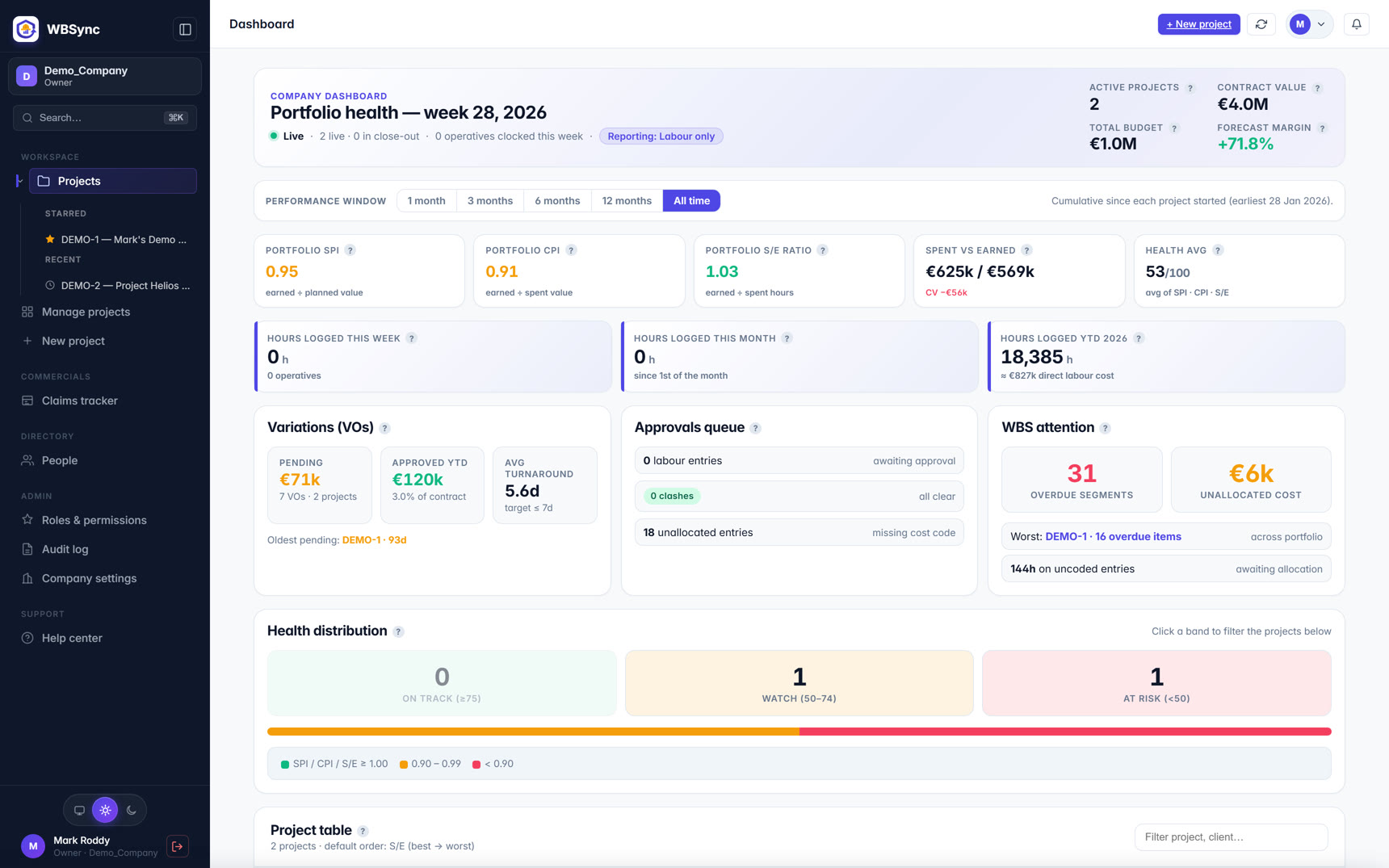
WBSync is built around a different question: not "is the paperwork done?" but "did the hours earn their value?" You import a four-level WBS and BOQ from your existing spreadsheets; hours arrive from a foreman's offline-capable crew-log PWA (operatives never need logins) or automatically from your existing clock-in system through an open inbound API with prebuilt vendor adapters; clash detection and a foreman/PM approval gate stand between every punch and the KPIs; and the dashboards report spent-vs-earned, SPI, CPI, EAC and TCPI live, with S-curves at every WBS level.
The commercial models differ in a way that matters on a real crew. Rhumbix publishes no prices; its packages page describes four tiers licensed per user, where "each individual member of your team with a login counts as a user license" — its own worked example counts 20 foremen among 25 licences. WBSync publishes five flat tiers (€249 to €4,999+ per month) priced by active operatives, with unlimited PM, foreman, QS and admin seats and a self-service 30-day trial.
Both products are credible choices for labour tracking, which makes the genuine differences — earned-value depth, clock-system openness, approval discipline, and pricing transparency — the whole story. Every factual claim about Rhumbix below links to a public source captured on the verification date shown above, and the combined column shows the (less common, but real) case for running both.
Reviews at a glance
| Product | Public rating | In one line |
|---|---|---|
| Rhumbix | 4.1 / 5 on Capterra (146 reviews) [source] | Capterra, GetApp and Software Advice share one Gartner review pool — treat the 4.1/146 as a single dataset. |
| Rhumbix | 4.1 / 5 on Software Advice (same 146-review pool) [source] | Recurring critical themes: app stability, approval-system friction, editing errors, cost-code lookup across jobs. |
| WBSync | No review-site listings yet | Launched 2026 — judge it on the 30-day free trial rather than star counts. |
Ratings are third-party review-site averages captured on 7 Jul 2026; they move as new reviews land. Always check the linked source for the current figure.
Where the typical setup breaks
When two tools both produce cost-coded timecards, the seam moves: the question is no longer whether hours get coded, but what happens to them next. In most stacks the timecards feed payroll cleanly and then the commercial side starts over — a QS exports the week, reconciles codes in a spreadsheet, and derives earned value by hand, if at all. SPI and CPI arrive days late and nobody quite trusts them, because unapproved, duplicated or over-cap hours went into the pile unfiltered.
Rhumbix addresses the paperwork half of this well — payroll-ready timecards and T&M tickets signed in the field. WBSync is built for the measurement half: budgeted hours and value ride in with the WBS import, every punch passes clash checks and an approval gate, and the earned-value indices recompute the moment an hour is approved. If your reviews of labour data end in an argument about whose number is right, that pipeline — not the capture app — is usually the culprit.
Feature comparison
| Feature | WBSync | Rhumbix | WBSync + Rhumbix together |
|---|---|---|---|
| Product scope | Labour tracking + earned-value management on a 4-level WBS | Field workforce management: timekeeping, T&M tickets, production tracking, forms, daily reports [source] | Overlapping capture; complementary outputs (T&M paperwork vs EVM baseline) |
| Earned-value metrics (SPI / CPI / EAC / TCPI) | Native, to PMI / ISO 21508 conventions, live on every dashboard | Not advertised on product pages; production tracking covers installed quantities and labour productivity [source] | WBSync supplies the EVM indices |
| T&M / out-of-scope work | Variation orders with BOQ import/export; no in-field owner e-signature flow | T&M tracked from submission to approval; stakeholder e-signatures collected on mobile in the field [source] | Rhumbix leads this row |
| Field time capture | Foreman crew-log PWA (offline-first); operatives need no logins | Mobile clock-in/out, kiosk mode on shared devices, crew or individual entry; offline mode in all tiers [source] | Either front-end works — one set of cost-coded hours |
| Approval discipline before KPIs | Hard gate: clash detection (duplicates, over-cap days) + foreman/PM approval before hours touch any KPI; full audit log | Approvals managed through the platform; timesheets export to payroll [source] | Route the shared hours through WBSync's gate for claims-grade numbers |
| Bring-your-own time clock | Open inbound clock API; prebuilt adapters for Deputy, ClockShark, QBTime, Connecteam, Hubstaff, Workflow Infinity | Time capture via Rhumbix's own app/kiosk; no third-party clock vendors listed on its integrations page [source] | WBSync ingests from the widest set of clocks |
| ERP / PM integrations | XLSX/PDF export of everything; payroll stays where it is | Sage, Viewpoint, Oracle, SAP, CMiC, COINS, Foundation, Acumatica and more; Autodesk Construction Cloud, Procore, Trimble ProjectSight; public REST API endpoints for most data [source] | Rhumbix leads this row |
| Pricing model | Published flat tiers €249–€4,999+/mo by active operatives; unlimited PM/foreman/QS seats | Custom quote; four packages licensed per user — every team member with a login counts as a licence [source] | Model your foreman count before comparing quotes |
| How you buy | Self-service signup; 30-day free trial (up to 30 operatives); cancel anytime | Contact sales for pricing; free trial and free version listed on GetApp [source] | Run both trials on the same week of data |
| Ownership / ecosystem | Independent product | Acquired by Autodesk (deal closed April 2026); Rhumbix states no anticipated changes to products or support [source] | Ask the Autodesk roadmap question in your sales process |
Each Rhumbix claim above links to a public source on their website. Spot a stale claim? Email hello@wb-sync.com and we'll correct it within 5 business days.
Two field-first tools, two centres of gravity
Rhumbix's product pages put timekeeping and time-and-materials at the centre: payroll-ready timecards "captured and submitted in a fraction of time", crew or individual entry, kiosk mode on a shared device, and cost codes associated with labour and equipment for productivity visibility. The T&M flow is genuinely differentiated — out-of-scope work tracked from submission to approval with stakeholder e-signatures collected on a phone in the field. If change-order paperwork is where your margin leaks, that flow deserves a serious look.
WBSync's centre of gravity is the earned-value position. The WBS import carries budgeted hours and value per node; approved hours price against each worker's rate; and SPI, CPI, EAC, ETC and TCPI recompute live, to PMI / ISO 21508 conventions, at every level of the tree. Progress reports and claim packs generate from the same numbers, so the figure a PM quotes on Tuesday is the figure the QS submits on Friday.
Earned value: advertised versus native
Rhumbix's production tracking records installed quantities and labour productivity in real time, and its marketing content discusses earned-value concepts. What its product pages do not advertise is native earned-value metrics — no SPI or CPI indices on the production-tracking, timekeeping or pricing pages as of the verification date. Its Data Explorer add-on suggests analysis is possible on exported data; that is a build-it-yourself path rather than a dashboard.
WBSync ships the indices as the default view. There is no configuration step between importing a WBS and seeing spent-vs-earned per node — which is the practical difference between "the data could support EVM" and "the team runs on EVM".
Approvals, clashes, and trusting the number
A live KPI is only as trustworthy as the weakest punch that reached it. Rhumbix provides approval management through its platform, and reviewer feedback on the Gartner-network sites mentions the approval system and error-editing as friction points — read those reviews and weigh them against your own workflow.
WBSync's approval gate is structural: hours do not exist for any KPI until a foreman or PM approves them, duplicate submissions and over-16-hour days are blocked as clashes that must be explicitly resolved, and every state change is audit-logged. Corrections happen with a stamped reason, never silently. For teams whose labour data feeds commercial claims, that audit trail is the feature.
Clock systems and integrations
Rhumbix captures time through its own mobile app and kiosk mode, and its integrations page lists an extensive ERP and project-management roster — Sage, Viewpoint Vista and Spectrum, Oracle (JD Edwards, NetSuite, E-Business Suite), SAP, CMiC, COINS, Foundation, Acumatica and more, plus Autodesk Construction Cloud, Procore and Trimble ProjectSight — with public REST API endpoints for most of its data. Dedicated third-party time-clock vendors are not listed there; time capture is Rhumbix's own front-end.
WBSync inverts that: the open inbound clock API is the front door, with prebuilt adapters for Deputy, ClockShark, QBTime, Connecteam, Hubstaff and Workflow Infinity plus a generic webhook. If your crews already clock through one of those, WBSync starts delivering EVM without changing anything at the gate. The trade-off is honest: WBSync's ERP integration list is far shorter — it exports XLSX and PDF and expects payroll to stay wherever it lives today.
Pricing and the Autodesk question
Rhumbix prices per user login on a custom quote across four packages (Essential Timekeeping, Essential T&M, Plus, Advanced), with SSO and Data Explorer as add-ons on lower tiers. Because every login counts — the pricing page's own example counts 20 foremen in 25 licences — headcount-heavy field teams should model the licence count carefully. WBSync charges flat tiers by active operatives with unlimited staff seats, published on its pricing page, so the number is knowable before any call.
The April 2026 Autodesk acquisition is recent and material: Rhumbix has said it does not anticipate changes to products or support, and Autodesk ownership may deepen the Construction Cloud integration story over time. Buyers should simply ask the roadmap question directly in their sales process.
The honest case against WBSync
WBSync launched in 2026 and has no review-site track record; Rhumbix has a decade of field history, marquee customers named in its acquisition coverage (Turner, Suffolk, DPR), and now Autodesk behind it. WBSync has no T&M ticket flow with owner e-signatures, a much shorter ERP integration list, and no equipment tracking. If those are your buying triggers, Rhumbix addresses them today and WBSync does not. Run the 30-day trial against one live project before deciding anything.
Implementation timeline
| System | Typical setup | What's involved |
|---|---|---|
| WBSync | Days | Import WBS + BOQ from xlsx, invite foremen, point your clock system at the inbound API. Self-service; no implementation contract. |
| Rhumbix | “Days not months” (vendor claim) [source] | Rhumbix's homepage claims implementation “in days not months”, with custom forms “trained and deployed in as little as 2 weeks”; per-user licensing and ERP integration scoping happen through the sales process. |
| WBSync alongside Rhumbix | Days | Less common pairing — realistic where Rhumbix handles T&M paperwork on cost-plus work and WBSync carries the EVM baseline on lump-sum scopes. |
Who should choose what
| Choose | When |
|---|---|
| Rhumbix | T&M and out-of-scope paperwork is your margin leak, you want owner e-signatures in the field, and you need deep ERP integrations (Sage, Viewpoint, Oracle, SAP) or the Autodesk ecosystem. |
| WBSync | Earned value is the deliverable: live SPI/CPI on a 4-level WBS, a hard approval gate with an audit trail, your existing clock kept, and published pricing that doesn't count foreman logins. |
| Both together | Cost-plus work runs through Rhumbix T&M tickets while lump-sum scopes carry a WBSync EVM baseline — a niche but coherent split. |
| Neither (yet) | You run fewer than ~10 operatives and a disciplined spreadsheet still works. Revisit when re-keying hours starts costing more than software would. |
Pricing
WBSync publishes its full price list: five flat-rate tiers, each with unlimited back-office users, priced by active operatives rather than per seat — see the pricing page for current figures and what each tier includes. Every plan starts with a free 30-day trial (up to 30 operatives, no credit card). Rhumbix's pricing model is covered in the comparison table above — where a vendor quotes custom pricing, budget for a sales process before you see a number.
Verdict — when to choose WBSync
WBSync is a better fit when earned value is the deliverable: live SPI/CPI on a real four-level WBS, an approval gate and audit trail you can defend in a claims meeting, your existing clock-in system kept, and published operative-based pricing that doesn't charge for foreman logins.
Rhumbix is a better fit when T&M capture is the deliverable: out-of-scope work signed by the owner's representative in the field, payroll-ready timecards, deep ERP integrations, and — post-acquisition — an Autodesk ecosystem play.
Running both is less common than with the platform vendors, since the products overlap on capture; the realistic combined case is Rhumbix for T&M paperwork on cost-plus work while WBSync carries the EVM baseline on lump-sum scopes. If you are choosing one, put your own week of data through the WBSync trial and judge the SPI you get against the reconciliation you do today.
FAQ
What's the single biggest difference between Rhumbix and WBSync?
Output. Rhumbix's flagship outputs are payroll-ready timecards and signed T&M tickets; WBSync's are live PMI/ISO 21508 earned-value positions (SPI, CPI, EAC) on a four-level WBS. The capture layer looks similar; what the hours become afterwards does not.
Does Rhumbix report SPI and CPI natively?
Rhumbix's product pages do not advertise native SPI/CPI metrics (checked 7 July 2026). Its production tracking records installed quantities and labour productivity, and its Data Explorer supports analysis on the data. Verify current capabilities in your own demo — especially post-acquisition.
How does the Autodesk acquisition affect this comparison?
Autodesk's acquisition of Rhumbix closed in April 2026. Rhumbix has stated it does not anticipate changes to products, service offerings or support. The practical buyer question is roadmap and pricing direction — ask it directly in your sales process.
How is Rhumbix priced?
By custom quote, across four packages, licensed per user — Rhumbix's packages page states every team member with a login counts as a licence, and its own example counts 20 foremen in 25 licences. WBSync charges flat published tiers by active operatives with unlimited staff logins, so compare like-for-like on your real headcount.
Can WBSync ingest hours from the clock system we already use?
Yes — that is the design. The open inbound clock API has prebuilt adapters for Deputy, ClockShark, QBTime, Connecteam, Hubstaff and Workflow Infinity, plus a generic webhook for anything that can POST a punch.
Is WBSync's earned value PMI-compliant?
Yes. SPI, CPI, EAC, ETC and TCPI follow PMI / ISO 21508 conventions, computed on approved hours only, with S-curves at every level of a four-level WBS.
Sources
Every factual claim about Rhumbix on this page is drawn from publicly available information on their own website, documentation, or pricing pages, captured on 7 Jul 2026.
- Rhumbix homepage (implementation claim, T&M, daily reports)
- Rhumbix pricing page (custom quote)
- Rhumbix packages detail — per-user licensing (www2 mirror)
- Rhumbix timekeeping solution
- Rhumbix production tracking solution
- Rhumbix integrations (ERP roster, public REST API)
- Rhumbix blog — Autodesk acquisition announcement
- Construction Dive — Autodesk acquires Rhumbix (closed 3 Apr 2026)
- Rhumbix reviews on Capterra (4.1/5, 146 reviews, pulled 7 Jul 2026)
- Rhumbix reviews on Software Advice (shared Gartner dataset)
- Rhumbix on GetApp (shared Gartner dataset; trial/free-version note)